

With the exponential growth in electronic health record data volumes and the rapid development of computer technology, the impact of AI on clinical trials has seen a consistent and remarkable rise. AI-based tools have demonstrated the ability to perform a variety of tasks throughout the conduct of clinical studies and to address many of the critical challenges associated with traditional clinical trials.
Challenges in clinical trials
In traditional clinical trials, the selection and recruitment of patient cohorts are critical factors that often contribute to trial failure. A large pool of patients does not guarantee trial success, nor does the recruitment of unsuitable participants. Additionally, the technical infrastructure required to manage complex trials may be lacking, particularly in the later stages. Traditional clinical trial models also face challenges in ensuring reliable and effective compliance monitoring, patient surveillance, and clinical event detection systems. For these reasons, clinical studies frequently run over time and over budget.
Another challenge concerns the enrolment of young adults. This patient population represents a vital demographic for future clinical trial participation. However, their enrolment generally occurs at lower rates than among children and older adults. Only 19.5% of 18–34-year-olds were recruited into clinical research in 2021 (National Institutes of Health). Young adults have distinctly different interests, values and motivations for participation, which need to be purposefully integrated into recruitment, engagement and retention strategies.
How AI can help address clinical trial challenges
Al has the potential to address these shortcomings through technologies such as machine learning (ML) and deep learning (DL).
ML focuses on developing algorithms capable of learning from data. It can automatically identify meaningful patterns in large datasets, including text, language and images, thereby accelerating clinical trials through patient matching and comprehensive data analysis. Human–computer interfaces facilitate natural information exchange between computers and humans. These capabilities can improve patient-trial matching and recruitment before study initiation, match patients with appropriate clinical trials, and enable automated and continuous patient monitoring throughout the trial process.
For example, a research team in the USA developed an AI-assisted system (Mendel.ai) for cancer clinical trials, which demonstrated significant improvements over conventional approaches in patient pre-screening, leading to higher recruitment rates and reduced recruitment times.
In 2020, an Australian research team introduced an AI-assisted clinical trial matching system specifically for patients with lung cancer. The system demonstrated an exclusion accuracy of 95.7% and a qualification assessment accuracy of 91.6%. These results suggest that the automated system can serve as a reliable clinical decision-support tool for pre-screening large patient cohorts and identifying suitable patient subpopulations.
By leveraging AI in clinical trials, researchers can enhance their ability to identify and manage risks, thereby improving overall trial outcomes. AI also plays a crucial role in analysing biomedical information and supporting decision-making during patient recruitment.
In cardiology, AI-enhanced mobile strategies may be particularly well suited to remote cardiac monitoring in trials requiring serial echocardiograms.
Well-executed digital tools may also help address existing health inequalities by identifying and recruiting marginalised groups that have historically been underrepresented in clinical research. AI technology can facilitate participation in decentralised clinical trials and new models of care by enabling the involvement of patients and clinicians from remote areas who were previously difficult to reach. For example, AI-based chatbots tailored to the needs and circumstances of disadvantaged populations have been used to improve participant education and engagement among marginalised groups. In a 2025 study, researchers reported that co-designed digital tools increased young adults’ interest in clinical trials and their likelihood of participating.
In addition, AI can significantly improve the efficiency and accuracy of clinical studies by helping clinical trial designers rapidly process information from similar studies, clinical datasets and regulatory documentation, while also supporting the interpretation of relevant data.
Challenges and roadblocks to AI adoption
The integration of Al into clinical trials offers a promising solution to many of the limitations associated with traditional trial methodologies. Although the technology has demonstrated its value in this domain, it is essential that innovations continue to undergo rigorous research and development to ensure their reliability and effectiveness.
Furthermore, the use of AI tools in patient recruitment and retention may raise technical, regulatory and ethical concerns. Appropriate governance frameworks are therefore required to safeguard the integrity, transparency and effectiveness of AI applications in clinical research.
A few examples of key roadblocks [From Hu J-R et al. European Heart Journal (2025)]: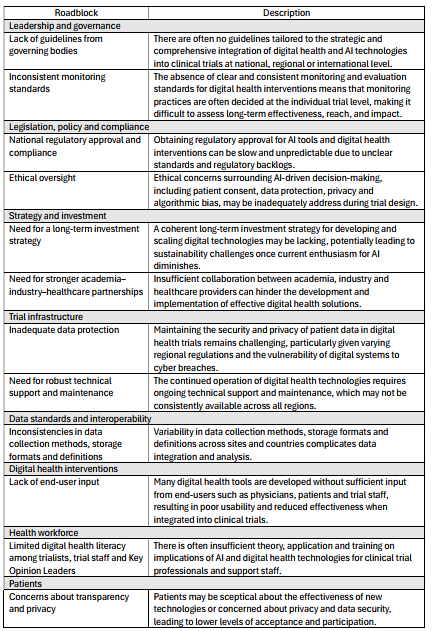
Conclusion
Understanding both the risks and benefits of emerging technologies such as AI is essential to revitalising clinical trials, which continue to face challenges relating to high costs, external validity and the underrepresentation of diverse populations.
Digital tools have opened new avenues for patient identification and trial population enrichment, translating into cost savings and a reduced risk of false-negative study outcomes.
The successful integration of digital tools into clinical research will depend on overcoming regulatory barriers, achieving clinical validation and acceptance, improving technological literacy, integrating with existing models of care, and addressing fragmented healthcare data systems.
If implemented successfully, digital tools have the potential to transform the efficiency, accuracy, and cost-effectiveness of clinical trials.
Sources:
- Hu J-R et al. Artificial intelligence and digital tools for design and execution of cardiovascular clinical trials. European Heart Journal (2025) 46, 814–826.
- Lu X, Chen M, Lu Z, et al. Artificial intelligence tools for optimising recruitment and retention in clinical trials: a scoping review protocol. BMJ Open 2024;14:e080032. doi:10.1136/ bmjopen-2023-080032
- Mackey T et al . Approach to Design and Evaluate Digital Tools to Enhance Young Adult Participation in Clinical Trials: Co-Design and Controlled Intercept Study. J Med Internet Res 2025 (vol. 27) e70852 ;p. 1-12.